The impact of monetary incentives and gamification on glucose levels: real-world assessment in people with diabetes
Baseline characteristics
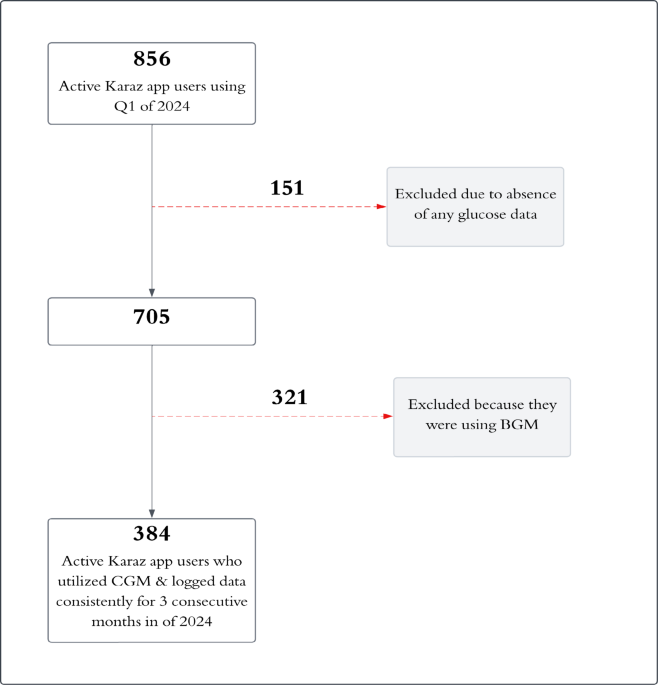
Of the 856 Karaz users who had any logged data during the first quarter of 2024, 384 users met the study inclusion criteria (detailed in the Methods section) and were included in the final analysis. Approximately 57% of the study participants were women and 78% had type 2 diabetes. The average (SD) age of the study participants was 23.64 (9.85) years. At baseline, the average TIR was 58.74%, TBR < 70 was 5%, TBR < 54 was 1.95%, TAR > 180 was 36.26%, TAR > 250 was 14.51%, TITR was 38.88%, GRI was 63, and glucose CV was 38.12%. The baseline average daily steps were 3274 steps and average daily sleep duration was 368.07 min (i.e., 6 h and 13 min). When stratified by baseline TIR (> 60% vs ≤ 60%), those with higher TIR were slightly older and had significantly lower TBR < 54; higher TITR; and lower TAR > 180, TAR > 250, GRI, and glucose CV. Moreover, those with higher baseline TIR had greater average of daily steps, albeit, not statistically significant, sleep duration, and number of cherries earned per day compared to those with lower TIR at baseline (Table 1).
Supp. Table 1 compares the baseline characteristics of Karaz users by their baseline average glucose level (≤154, 155-169, 170-183, and >183 mg/dL). Those with baseline glucose ≤154 mg/dL had higher TIR (72.48%) and TITR (51.34%) and lower TAR >180 (20.97%), TAR >250 (4.76%), and GRI (46); but also, higher TBR <54 (2.57%) and TBR <70 (6.55%) compared to the other three groups (p<0.01). No significant differences in glucose CV were noted across the four groups (p=0.06). In addition, users in the baseline average glucose ≤154 mg/dL group earned significantly more cherries (mean: 528.57 cherries/day) for engaging in healthy behaviors compared to the other groups (p<0.01). The same group also had a significantly longer average sleep duration (410.56 minutes “approximately 6 hrs and 50 min”) than those in the higher baseline glucose groups (p=0.03). Whereas the average daily step counts did not significantly differ across the four baseline glucose groups.
Changes in CGM metrics and other health outcomes over three months
Karaz users with baseline TIR ≤ 60% had statistically significant improvements in the following CGM metrics from baseline to month 3: [TIR: 43.10 to 45.89% (p < 0.01), TAR > 180: 51.83 to 48.79% (p < 0.01), TAR > 250: 24.66 to 22.50% (p < 0.01), TITR: 25.54 to 27.84% (p < 0.01), and GRI: 87 to 84 (p < 0.01)]. In contrast, those with baseline TIR > 60% did not experience statistically significant changes in CGM metrics from baseline to month 3 except for the following: [TIR: 74.88 to 73.53% (p = 0.01), TAR > 250: 4.03 to 4.81% (p = 0.03), and GRI: 39 to 42 (p < 0.01)]. No significant changes were noted in the average number of daily steps nor sleep duration from baseline to month 3 in either group (Table 2). Both groups, however, had a significant increase in the number of cherries earned per day from baseline to month 3.
Likewise, Karaz users with the highest baseline average glucose (i.e. > 183 mg/dL) had significant improvements in the following CGM metrics from baseline to month 3: [TIR: 31.09 to 36.38% (p < 0.01), TAR > 180: 66.38 to 60.62% (p < 0.01), TAR > 250: 37.95 to 32.88% (p < 0.01), TITR: 16.68 to 20.52% (p < 0.01), and GRI: 98 to 93 (p < 0.01)]. In contrast, glucose CV in the same group of patients increased from 37.92 to 38.91% (p = 0.01). The average number of cherries earned per day increased significantly from baseline to month 3 across all the four groups (≤ 154, 155–169, 170–183, and > 183 mg/dL) (Supp Table 2).
Table 3 compares the baseline characteristics of those who had a clinically significant improvement in TIR by > 5% to those who had the same or worsened TIR over three months. Those with improved TIR had the lowest baseline TIR and TITR (both p < 0.01) and highest baseline TAR > 180, TAR > 250, GRI, and average daily steps (all p < 0.05).
Univariate and multivariable logistic regression analyses
In the unadjusted model, Karaz users with baseline TIR < 40% were eight times as likely to achieve the clinically meaningful improvement in TIR by > 5% over three months compared to those with baseline TIR > 70% [OR, 95% CI: 7.61 (3.36 – 17.21)]. This association remained the same even after adjusting for age, gender, baseline TBR, and baseline number of steps per day. Similarly, those with baseline TIR of 40–70% were four times as likely to achieve a significant improvement in TIR over three months compared to those with baseline TIR > 70% [OR, 95% CI: 4.09 (1.93 – 8.70)]. This association became stronger after adjusting for potential confounders [OR, 95% CI: 10.25 (2.78 – 37.86)] (Table 4).
link